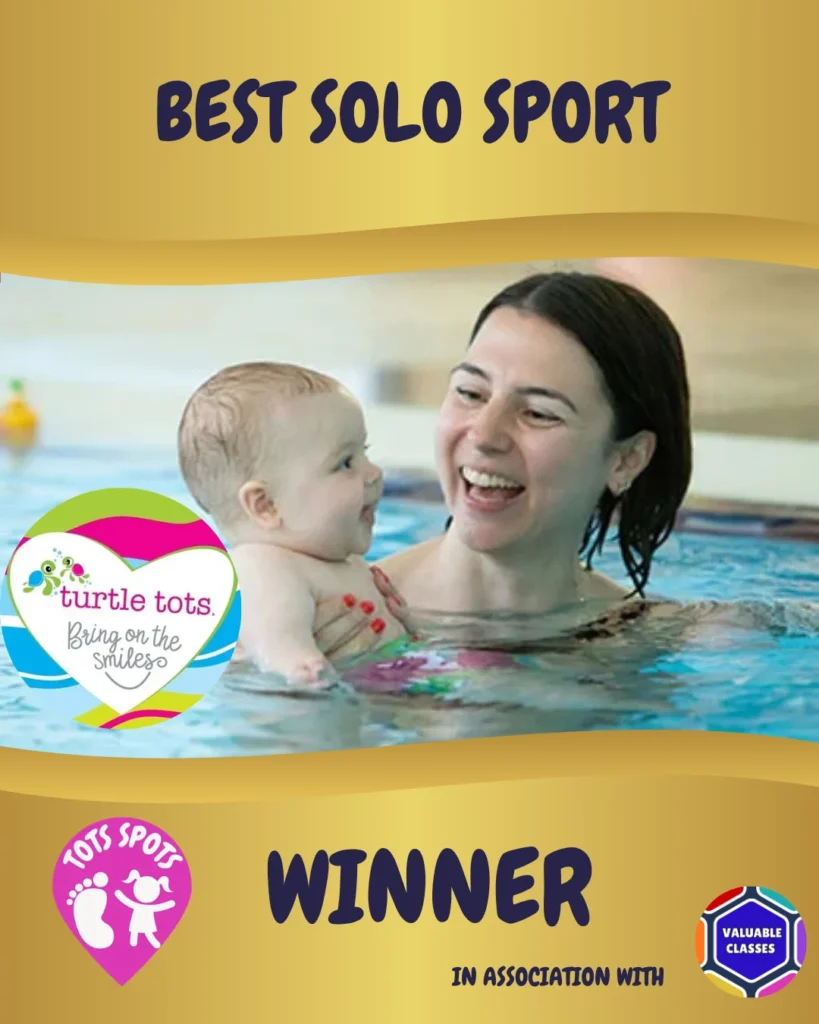
We are delighted to have won a Tots Spots 2026 Award for Best Solo Sport! The Tots Spots Awards are an annual awards program in Ireland designed to recognize and celebrate the best baby, toddler, and children’s classes, groups, and activities.
What makes this award highly meaningful for us is that it is entirely community-driven. Winners and finalists are nominated and voted for directly by the parents, caregivers, and families who attend these classes.
Thanks so much Tots Spots for supporting our baby toddler and preschool swimming lessons, it’s super appreciated.
Here at Turtle Tots, we get asked all the time about underwater photoshoots for babies and whether we offer them. For lots of new parents, the ‘Nirvana’ shot is on the bucket list of photographic memories and a key motivator for getting involved in baby swimming lessons.
We do offer underwater photoshoots for babies and toddlers approximately twice per year in Dublin, Cork, and Galway, and they’re always lots of fun. But we’re going to be upfront and admit that photoshoots are not our top priority, and definitely not something we offer at the end of every term, or for every student. When we do offer them, we take care to ensure that everyone participating knows what they’re in for, and that our kids are ready and willing too.
We’ve photographed thousands of babies over the years, and we’ve definitely learnt a thing or two about how to get the best images on the day. And what we’ve learned is that preparation is everything. Little ones well experienced with going underwater and are initiating submersions themselves, are comfortable going to new people, and are just generally having a feel-good day are the ones who are going to steal the show. Those are the images you’ll hang on your wall with pride and people will say ‘wow!’ when they see them for years to come.
And we’re going to be honest and say that it’s the underwater swim itself which presents the biggest challenge for most little ones. It’s a really big achievement to be ready for the swim we use for the photos: babies will be fully released just below the surface, and swim all on their own for 3 to 5 seconds before collection. The swim has to be long enough for the instructor to step away – after all, you don’t want arms or legs in the background, and bubbles need to clear so we can see their gorgeous faces clearly. That swim is more than just a ‘mini-dip’, it’s a proper swim for little babies! Once you’ve mastered this swim at class (usually around the end of your second of third term) and if your little one isn’t struck with a case of ‘stranger-danger’, it’s the perfect time for your family’s photoshoot.
A: Unfortunately, no. We simply do not teach released submersion swims in our first baby level, Turtle (3-8 months). It goes against our child-led ethos to force a long submersion for any child, and young babies are rarely submerging for that long of their own free will or showing signs that they wish to do so.
A: We introduce released submersion swims from our second baby level, Seahorse (7-11 months), and by the end of our third level, Dolphin (10-15 months) it’s a well practiced skill. You’ll have plenty of opportunity at class to see for yourself if your child is relaxed and happy with their underwater swims, and when they are: well, that’s your cue to join in at our next photoshoot!
A: If a baby is happy to submerge, you’ll know! From the first minutes of class when we blow ‘bubbles’, they’ll be happily sticking their faces right in the water to blow too. When you give the cue ‘Name, Ready, Go!’ before submersion their body language should be relaxed and leaning in – and then when you go under with them, you should see that their body remains relaxed and their facial expression calm. Afterwards, they should be calm and happy, and ready to go again!
Signs that your little ones is not ready would be if they are arching their backs away from the water at the surface, tensing their body as you give the cue to go underwater, or if you observe widened eyes, arms very wide and stiff, or tightly closed fists once they are underwater. If they didn’t like their submersion swim, chances are they’ll let you know afterwards too 🙂 If you observe these signs, you should hold off attending a photoshoot for the time being – it could end up being a bad experience for them and for you, and you won’t get the photos you want either.
A: When we have a photoshoot upcoming, we’ll let you know. They’re usually around April and November. We’ll give about a month’s notice – we try not to schedule and book them too far in advance, because a lot can change for our young students, even in a month!
Photoshoots cost €100 per child and includes the session itself (30 minutes, group session), and all of the images in a high quality, digital format for you to download and keep forever. A few weeks after the photoshoot, we’ll send you all of your gorgeous images to download via a link.
For many years, we’ve donated a portion of termly fees to Heart Children Ireland and the Irish Kidney Association. This year, we wanted to go even further — so we’re holding our annual Duck Race (actually, lots of them!) to raise money for another incredible Irish charity: Childhood Cancer Ireland.
The child who raises the most sponsorship will win a whole term of Turtle Tots classes — completely free! Our Duck Race 2025 winner will be announced in November 2025, and the winner notified by both phone and email.
During the week 18 to 24 of October 2025, we’ll be making classes extra fun with our very own Duck Races.
Every swimmer is invited to collect sponsorship for their duck. We hope friends and family will support your child and help raise funds for this worthy cause.
✨The winner of each class will take their duck home!
✨ Everyone else can also take their duck home in return for a small donation.
If your child takes their duck home, we’d love to see their duck’s adventures around your town!
When you’ve completed your sponsorship form, there are three ways to donate before 24th October:
After the deadline, we’ll announce the top fundraiser and present the funds to the charity.
Every little helps — please don’t feel pressure to raise huge amounts. If each of our little Turtle Totters raised just €20, together we could donate over €50,000!
Childhood Cancer Ireland is a parent and survivor-led charity, founded by families who know first-hand the devastating impact of a childhood cancer diagnosis.
They raise funds to provide practical and emotional support for children and families, while also advocating for better treatments, services, and outcomes across Ireland.
👉 Hear inspiring stories here: Gold Ribbon Stories
👉Watch Oisín’s dad share his journey here: Oisin’s dad’s video
We know everyone is busy, so we deeply appreciate anyone who chooses to get involved. We promise the Duck Races will be full of laughter, memories, and purpose — while raising vital funds for children, babies, and young people across Ireland and beyond.
A heartfelt thank you from all of us at Turtle Tots Ireland.
Jumping is a key element of developing a child’s motor skills, and it’s a huge milestone for toddlers when they jump into the pool for the first time. It’s a skill first introduced in our Octopus level, and an important one because it really is a leap of faith, for you and for them!
From the very first time they jump in from the side or the mat, you can see the pure joy on their little faces. It’s a fun activity we encourage and love to introduce in the safe and supervised space of our lessons.
Once babies and toddlers can stand, they’ll start learning to first step out, and then later jump, into the pool for you to collect. We’ll teach them to wait and listen until they hear your cue – this is really important – and then to look before they leap. Safety always comes first.
To begin with, babies will stand on a thick foam mat supported by their teacher – this prevents any accidental falls from doing any harm. Walking to the edge and holding their parent’s hands, their first big step over the edge is totally on their terms – and from their perspective, it looks a long way down! The excitement, the thrill, and most importantly the splashes and the giggles afterwards fast become every kid’s favourite part of their lesson.
In the following weeks they’ll build up the confidence to jump without you holding their hand; toes to the edge, knees bent, and jumping away from the wall and under the water before being scooped up in to the safe arms of their parent.
Simple phrases like “1-2-3, Jump!” or “Ready, Set, Go!” help both of you to communicate safely when it comes to jumping in. At first, kids will want to leap in as soon as they are standing up, it’s just too much fun! But, it’s easy to see how this behaviour might cause an injury, or even worse, a drowning risk. We’ll teach kids to listen and wait until you say their favourite words before they leap. Learning to jump in the right way keeps them safe, and teaches an essential life skill at an age when kids need it most. We’ll keep it fun and light-hearted, whilst giving you some peace of mind.
Whether they do a full jump or just dip a toe, celebrate it! Positively builds confidence and self-esteem. High-fives, claps, or a little splishy splashy song all go a long way 🎶 Jumping in is an important submersion skill and building block for more advanced skills later, but it does take courage and trust. What seems like one small step to you can mean a giant leap to them, and when it does happen, you’ll both be jumping for joy.
Has it been a few weeks of your first swimming lessons, and your little one just isn’t settling in yet? It’s disheartening when those first lessons weren’t the experience you’d hoped for, but the good news is you’re only at the start of your journey! With the right advice and perseverance it will get better, so don’t give up yet. This is an important parenting opportunity.
In the preverbal stage when babies are very little, it’s difficult to exactly know where it’s going wrong for them, and so when it comes to addressing what’s happening, we need to take a holistic approach.
Once a baby born full-term is 3 months of age, it’s not likely that they’re too young physically for our swimming lessons. When we talk about an age to start swimming, it’s due to the physical demand of being in water for 30 minutes – newborn’s just aren’t aren’t able for a 30-minute session in 30c water, its too tiring for them. Beyond 3 months or age, if your little one is getting progressively more upset as their lesson gets underway, then we need to look at the possible causes, which could be simple or little more complex.
The first considerations are;
If it’s none of these physical factors, then being that it’s only very early days it’s not likely that they’ve developed an aversion to swimming – after all, they’ve not had much chance to experience it. It’s likely to instead be overstimulation.
Turtle (3-8 months) takes its pace very slow, and this is fully intended. We want to allow babies time to adjust to the aquatic environment, the first sessions are a lot for babies to take in and process. Babies can very easily get overstimulated, some more than others too. A hotel pool environment is very noisy compared to a quiet home especially if they are the first child, and sound is loud and travelling differently than they’re used to. The lighting is bright, and light can be scary the way it reflects off water. There’s a lot of other people and babies at class, which can be overwhelming. And we haven’t even gotten into the water yet!
Getting into the pool when a baby is already overstimulated is likely to tip them over the edge. Overstimulation looks like fearful whimpers at the start of a class that build in to a full-blown cry after around 5 minutes. It’s a totally normal occurrence for babies and children getting started with swimming lessons, but when it happens it can be very distressing for you and for them. In part, that’s because there’s not much we can do in that moment to recover the situation. Toys or distractions haven’t worked, you’re suddenly the ‘wrong’ parent, and they will roar until the scary things go away (as in, you get out of the pool).
The good news is that overstimulation is easily dealt with and moved on from once you know what to look for. So, try again next week with the idea of overstimulation in mind, and see if by addressing it you can move past it.
It’s important that you lead with calmness. If you feel stressed or anxious (which is only fair when the first few lessons haven’t gone well!) then your body language is probably saying it loud and clear. Babies are experts on picking up how their parents are feeling and will react to it, this is called co-regulation. So, take a moment to centre your breath, keep a smile on your face, and hold on to a belief that everything is going to be ok – because it is! Another tip is to relax your hands and body – nervous parents will have a stiff body and a tight grip which babies will feel and react to. This is one of those times where you really do need to fake it until you make it 😊.
If that’s as far as you get on your next attempt, and baby stays calm throughout the process, it’s a huge step forward! The following week, you might find you only have to sit poolside for 5 minutes, or a minute or two is needed settle before your class, but before you know it, you’ll be flying. When you do join in, avoid any overexcited classmates, splashy little arms or legs, or loud parents, at least for the first few weeks.
Lastly, don’t be worrying about the other parents and what they’re thinking, that only makes everything worse! Remind yourself that they’re all parents too, and they know you’re doing your best. You’re doing a great job just by showing up! Our lessons are a safe space and without judgment, and absolutely everyone has bad days. Yours just happen to be at the start, but you’ll be so proud of yourself when you see it through.
Let’s be honest; pregnancy is hard on your body. Even if you had the most blissful, calm and comfortable pregnancy, those months take their toll. It’s great you’re considering swimming lessons for your new bundle of joy, the benefits of this great activity are many! But have you considered of the benefits for your own health too? There’s more than you might think.
Swimming is incredible for gentle exercise, and our baby swimming lessons are no exception. Our baby curriculum incorporates considered and gentle exercise and is designed to help moms on their postpartum recovery. It’s definitely nothing too strenuous or exhausting, but our weekly lessons can help towards feeling like yourself again. Warm water offers relief from an aching back or joints, and some gentle stretching movements can help tired muscles. As your baby grows, we’ll use their body weight to help tone and strengthen your arms and core too.
Aside from some physical perks, there are great mental benefits too. Parents tell us their time in class offers an incredible bonding experience. You’re in the water and away from any chores, phones or distractions. For that half hour, you’re in the moment; you and your little one are focused on each other, doing something enjoyable and meaningful together. You can leave everything else at the changing room door. And this time isn’t just reserved for moms, Turtle Tots lessons also give a great supported bonding time to new dads or even grandparents whilst mammies take a well-earned break!
Our lessons are an excellent way to meet and connect with other parents of babies the same age. We love to see parents arrange after-class coffee or a group WhatsApp. You and your baby will get to socialise and build relationships with other families in your area going through shared experiences and milestones. Turtle Tots classes are a wonderful reason to get out of the house every week and do something meaningful. Especially in those early days when you might find yourself living in pyjamas and developing cabin fever, having a motivation to get out in to your community and meet new people can have a huge positive impact on your mental health and mood.
Lastly, baby swimming is beneficial for you because it’s fun! You will LOVE seeing your baby developing and progressing throughout the term and get some peace of mind as they’re learning about water safety and awareness. It’s a win-win! But come and see for yourself. With over 50 locations around Ireland, you’ll find our award-winning Turtle Tots lessons available in a pool near you and a new term starting soon.
When the sky is blue and the sun is shining, it can be hard to imagine why at Turtle Tots we keep insisting on thermal layers for our baby swim lessons. You’ve just bought a gorgeous little baby sunsuit for that holiday abroad, and it’s a shame to see it go to waste. Surely the pool is warm enough without a baby wetsuit, right?
Here at Turtle Tots, our main focus is to provide a safe, warm and of course fun environment for each and every one of our special little ones. Every pool selected by Turtle Tots for our lessons is individually assessed to ensure it’s suitability for our baby, toddler and preschool swimming levels. The STA recommends that pools should be at least 32c for babies 2 months or younger, and 30c for babies under 12 months. Once in the toddler years and beyond, there is no recommended minimum temperature for lessons, but most prefer at least 28c or above for comfort. Our pools are always meet these standards or exceed them every day that our lessons are on, or our lessons don’t go ahead. Each teacher completes their own safety checks independent from the leisure centre’s test equipment before our lessons can begin too.
Newborn babies (0-2 months) haven’t yet developed enough physically to self-regulate their core body temperature, and it is so important when swimming during the newborn phase that the water temperature is very warm (ideally 32-34c) and swim time is kept short,15 minutes is plenty. Our pools are warm, but only a few are that warm (we call them hydro-pools), and because our lessons are 30 minutes long on top, here at Turtle Tots Ireland we ask parents to wait until babies are at least 3 months of age before joining our lessons. Babies two months old or younger will find 30 minutes at 30c overly tiring and perhaps even stressful. If your baby is premature, please use their adjusted age to calculate when to start. Also, we think babies benefit so much more from the skills we teach when they’re just that little bit older too 🙂
It’s somewhere between 3 and 6 months of age that babies will begin to develop core temperature regulation abilities, and it’s not until around 9 or 10 months that they can do it really well. It takes a lot of energy to stay warm, and until babies are getting plenty of extra calories after weaning, they need a little extra help with it. This is why at Turtle Tots we strongly encourage dressing your little one in a Warm In One or Baby Wrap wetsuit, along with their Happy Nappy. Thermals will help keep your baby comfortable for far longer than possible without one. An added benefit of baby thermals is they also reduce water sensation on sensitive skin, which can be overwhelming in what’s already a very stimulating environment.
We understand every child is different and you know them best, so after they’ve been attending for a term or two, you may notice that they don’t need a thermal any more (some babies run hot!) or they may need something less insulating, like a Thermaswim. So, go with your gut and remember our highly trained teachers are always there to help and offer guidance too – all our teachers have ‘spare’ swimwear you can loan a thermal layer for a lesson or two and see if it makes a difference before you invest. As children leave their baby and toddler years behind, they will be more active in the water and less likely to notice if the pool is a little cooler than those we teach our baby swimming lessons in.
Dress your baby in their swimwear only after you have arrived at the leisure centre, and shortly before you hop in. Never dress a child in their thermal swimwear and transport them in their car seat – this can cause over heating, especially on hotter days. As we mentioned earlier, young babies cannot regulate their core temperature very well, and can overheat easily. Dressing your baby too early in thermals can also make them feel cold when entering the water later too, as their body temperature has risen dramatically – a literal shock to the system! Also, those swim nappies they’re wearing underneath are not designed to hold liquids, so you could very quickly end up with a mess which leads to delays before you can get swimming.
Don’t arrive too early – 15 minutes is plenty of time for both of you to get ready. After dressing, it might be tempting to go stand poolside where the air is a going to be warmer, but we advise waiting in the changing rooms until just before class. Firstly, there’s likely more space for children and parents to chat and relax before their lesson, but more importantly, the air temperature poolside can be very warm – too warm for little ones in thermals to be there more than a few minutes before getting in.
So, now it’s time for class and the magic that comes with it! You and your baby or toddler will create memories that will last a lifetime. Bring a towel poolside for the younger ones to keep them nice and toasty when they get out, and once they’re all snuggled up, the post swim sleeps are the best! Remember at Turtle Tots, we are always here to help, we’ve seen and heard it all, so don’t be shy! Check out our online shop for our tried and tested swim wear range, or our news for some more tips and tricks to make your Turtle Tots journey even more special.
Our children are our most precious gifts and as parents we want to make sure they are always healthy, happy and safe; making sure they are confident, and safe in and around water from an early age is an important part of this.
Getting babies familiarised with aquatic activities from a young age and helping them to develop this lifelong activity is our passion; and we believe the best way to do this is to create a safe, warm environment in which young children can be introduced to water while having lots of fun.
Playing with your baby in water helps them to feel safe and secure, and it helps boost their confidence. This is thanks to the skin-to-skin contact, regular eye contact and big smiles.
Teaching babies in water relies very heavily on this empathy and awareness on the part of the parent. A calm relaxed approach achieves far better results that an anxious fearful one – young babies have no concept of fear, they accept every new experience they are introduced to by smiling or crying, relying on the empathy of their parents to positively guide them.
As specialists in baby and toddler swimming lessons, we also recognise that every child is different, and our lesson programmes have been designed to be truly child-centred. Each child is nurtured, and activities are adapted by our highly trained and skilled teachers to meet each individual’s needs.
To nurture water confidence, we use games, toys, songs, rhymes, blowing bubbles in our lessons to create a playful learning environment, where this is a strong focus on teaching lifesaving skills. We help babies learn the skills they need in a fun way, to help keep them safe in and around water, until they are able to swim independently.
To help you prepare for baby swimming lessons and nurture your baby’s water confidence, here are our top 5 tips:
Bath time is the best way to get your baby used to the water and to build their confidence. For new-borns, water is a natural environment, and fostering this natural affinity to water with fun bath time activities will make the transition to swimming pool much easier.
To ensure they are safe at bath time, fully support your baby and make eye contact, and then encourage them to splash their hands and kick their legs. Introduce sponge toys, and gently sprinkle water over their body using a toy watering can while singing songs or nursery rhymes to help relax them.
Take one of their favourite bath toys along to the pool to play with too; having a familiar toy with them will help your baby to relax and enjoy their first swimming lesson.
If you feel anxious about the water, don’t let this stop you from missing out on the joys of baby swimming because our lessons are the perfect way to help you overcome your nerves – it’s not only our little turtles that our teachers are empathetic with, it’s also the parents and they will guide you at every stage, at your own pace, to ensure you and your baby both have an enjoyable experience in the water.
Swimming with your baby is a special bonding time, but if its your first trip to the pool you might feel a little daunted, so to ensure your experience is a confident and positive one … get everything you need for your lessons ready in advance, i.e., swim nappies, towels etc and check how long it takes to get there. This will help you feel relaxed on the day – and if you are relaxed, baby will feel relaxed too.
This is our motto. During lessons, we encourage our parents to give their baby lots of praise, smiles and eye contact. This will help your baby to feel at ease in the water.
During our lessons, teaching babies how to float is an important lifesaving skill, and we encourage all our parents to use the techniques they’ve learnt in the lessons to carry this on at home at bath time (starting by fully supporting them in the water). Teaching young children how to float is a key skill that could save their life if they fell in water.
But most of all have fun, baby swimming is a magical experience.
Bringing your little one for their first baby swimming lessons is an exciting milestone! You’re not just teaching them a vital life skill but also opening a world of fun and confidence in the water. However, amidst the excitement of buying baby’s first swimsuit and googling what swim nappies they need, there’s a crucial consideration often overlooked by the untrained eye: the pool itself.
It might seem like any pool will do, but when it comes to baby swimming lessons, the environment plays a starring role in your child’s comfort and safety. Choosing the right pool isn’t just about convenience; it’s about setting the stage for a positive and enriching introduction to aquatic adventures. That’s why we take the process of selecting pools extremely seriously here at Turtle Tots.
So, before you dive in, let’s explore why careful consideration of the pool facility is paramount for your baby’s swimming journey and what criteria we look for when partnering with a pool owner to deliver our award-winning baby, toddler, and preschool swimming programme.
Selecting a pool that is the right temperature for your little one is our number one priority. Babies, especially newborn, are not as good at regulating their body temperature as adults and can get cold much faster. We always follow the Swimming Teachers’ Association (STA) guidelines. A pool that is too cold can lead to discomfort, shivering, and even hypothermia, making your little ones first experience in the pool unpleasant and potentially dangerous. On the flip side, a pool that is too warm can also be detrimental, leading to overheating or lethargy. For optimal comfort and safety, we operate our swimming lessons in pools that can be heated to the recommended temperature which is 30°C for babies over 3 months. A properly heated pool ensures your baby can relax, enjoy the sensory experience of the water, and focus on learning, rather than being distracted by the chill.
Beyond a comfortable temperature, the cleanliness and hygiene of the pool are non-negotiable for our baby swimming lessons. Babies have developing immune systems, making them more susceptible to infections from bacteria and viruses.
We always look for a well-maintained pool which has clear water, free from visible debris, where the owners adhere to strict chemical balance guidelines, particularly concerning chlorine levels.
While chlorine is essential for disinfection, too much can irritate a baby’s sensitive skin and eyes, and too little won’t effectively kill germs.
At Turtle Tots, we always work with facilities that prioritise hygiene, have excellent maintenance procedures in place, and ensure that the pools and their environments are always clean and safe.
The physical dimensions of a pool can play an important role in the enjoyment of your baby or toddler swimming lessons. Ideally, we operate our swimming lessons in a small pool, or a dedicated shallow area, roped off area, or lane in a larger pool with a consistent depth, typically around 1-1.2 meters. This allows parents or carers to maintain a good standing posture and provide a sense of security for their child.
After a fun and stimulating Turtle Tots swimming lesson, your baby will be ready for warmth, comfort, and perhaps a feed. This is where changing facilities become incredibly important, transforming what could be a stressful ordeal into a smooth and positive experience. When assessing a potential new pool, we look for changing areas that are clean, warm, and spacious enough to comfortably manoeuvre a baby and everything that comes with them to their lesson.
When the post-swim routine is efficient and comfortable, it contributes significantly to a baby’s overall positive association with the pool.
Here at Turtle Tots, we understand that establishing a consistent routine for your baby is crucial for their well-being, providing a sense of security and predictability that helps them feel safe.
Once set, many parents are loathe to change their little one’s sleep or feeding schedule for a swimming lesson. Therefore, finding pools where we can offer a variety of times to our families is key. That way, parents can choose a time slot that works around their baby’s schedule wherever possible.
While the pool environment and changing facilities are crucial, the convenience and quality of the broader venue also play a significant role in making baby swimming lessons a stress-free and enjoyable experience.
Easily accessible parking is a true lifesaver for parents juggling car seats and swimming bags. That’s why, whenever possible, we partner with pool facilities that offer sufficient parking facilities, close to the pool.
Beyond parking, we also look for any additional facilities that could support the wellbeing of our Turtle Tots families. Some pools even offer an on-site café, providing a convenient spot for parents and carers to meet for a post-swim snack and coffee – a small luxury that can make a big difference to a new parent’s day.
Ultimately, selecting the ideal pool for your baby’s swimming lessons is about more than just convenience; it’s about creating a foundation for a lifelong love of the water. From the optimal water temperature and hygiene that safeguard their delicate systems, to the right pool size and depth that builds confidence, every detail matters. Add to this the comfort of suitable changing facilities, the flexibility of lesson times that suit your baby’s routine, and the practical benefits of good parking and an on-site cafe, and you have an environment where your little one can truly thrive.
At Turtle Tots, we meticulously consider all these elements when choosing our partner pools, ensuring that every aspect of your baby’s swimming journey is as positive, safe, and enjoyable as possible. Because when the environment is right, your baby can focus on what truly matters: making a splash and learning vital life skills in a fun, nurturing space.
*Whilst our aim is to partner with the highest quality swimming facilities, sometimes the pools we teach in don’t quite meet ALL the requirements listed above. However, you can find details of each pool’s qualities on our website, and we always communicate fully with our customers prior to starting their lessons so that they know what to expect.
It’s Children’s Mental Health Week, a vital opportunity to focus on the emotional wellbeing of our children. This week is all about raising awareness, breaking down the stigmas surrounding mental health, and empowering children to understand and manage their own emotional wellbeing. At Turtle Tots, we believe that supporting children’s mental and emotional health is just as important as their physical development, and we’re proud that our swimming program offers a fantastic way to nurture both.
Think about it: what’s more freeing than the feeling of weightlessness in the water? Swimming isn’t just about learning a life-saving skill; it’s a powerful tool for promoting positive mental health from a young age. Our toddler, preschool, and independent swimming lessons offer a wealth of benefits that extend far beyond the pool.
Swimming offers a unique combination of physical activity, sensory experience, and social interaction, making it an incredibly valuable tool for supporting children’s mental health. It’s more than just a sport; it’s an investment in their overall wellbeing, setting them up for a happier, healthier future.
This Children’s Mental Health Week, let’s celebrate the power of swimming and the positive impact it can have on our little ones’ lives.
Swimming with babies is an exciting and rewarding experience for you and your little one. Whether you’re introducing your baby to the water for the first time or you’re an experienced parent ready to dive in, it’s important to know what to dress your baby in when swimming.
This guide will help you navigate different baby swimwear options and ensure that your baby is warm and comfortable during their water adventures.
For any children who aren’t potty-trained, a swim nappy is a must. There are two types of swimming nappies available:
Check out our range of size-adjustable reusable swimming nappies, available in a selection of gorgeous patterns.
Most swimming lesson providers, including Turtle Tots, require babies and toddlers to wear a double nappy system for extra protection against leaks and to keep pool environments as hygienic as possible. This means wearing a disposable or reusable swim nappy with a Happy Nappy over the top.
The Happy Nappy is designed for your baby’s comfort with neoprene sleeves around the waist and the top of baby’s legs to ensure nothing gets out!
For complete convenience, The Happy Nappy Duo is an all-in-one double nappy system which means there’s no need for a reusable or disposable swim nappy underneath it, helping the environment and making life easier.
If the pool you’re swimming in is on the cooler side, or you simply just want to add extra style or protection to your baby’s swimwear, there are lots of great options available.
Choosing the right swimwear for your baby is essential for their comfort, safety and warmth in the pool. From swim nappies to extra layers for warmth, there are various options to suit your baby’s needs. Whether you choose a disposable or reusable swim nappy, or opt for the convenience of a double nappy system with the Happy Nappy, you’ll be well-prepared. With added warmth from products like the Happy Nappy wetsuit or the Warm In One fleece-lined wetsuit, your little one can enjoy swimming in comfort and style.
Happy swimming!
Taking your baby swimming is a wonderful way to bond and promote early physical development. However, when winter arrives, some parents hesitate to take their baby swimming, concerned that they might get too cold. The truth is, taking your baby swimming year-round is crucial for maintaining your baby’s confidence in the water and sustaining their progress. Plus, the benefits of baby swimming remain consistent throughout the year.
In this article, our experts share five top tips for taking your baby swimming in winter, ensuring a warm, safe and enjoyable experience for all.
One of the most common questions we receive is, “What temperature does the water need to be for baby swimming?” The ideal water temperature for babies is between 30°C and 32°C, however for babies over three months old it is absolutely fine to swim at lower temperatures although your baby may need a warming wetsuit. Many baby swimming lessons are held in temperature-controlled pools, making winter swimming lessons a great option. If you’re unsure about the water temperature, don’t hesitate to call the pool or your local swim school in advance to confirm. If you can’t find a pool at the right temperature near you, our next tip will help.
Choosing the right swimwear is essential for keeping babies warm in the pool during winter swimming sessions.
Here are three of our top recommendations for baby wetsuits:
Considering how to keep your baby warm before and after swimming is really important for maintaining warmth. When it’s cold outside, babies are more likely to feel chilly, even before entering the pool. To keep your little one cosy, wrap them in a soft towel or blanket while you change into your swimwear.
After swimming, dry your baby off as soon as possible with a soft, warm towel, and dress them in layers of clothing to keep them warm. A warm hat can also be helpful, as babies lose a significant amount of heat through their heads.
Babies are very sensitive to changes in temperature and their bodies are more prone to getting cold quickly, especially in cooler pools. Watch for signs that your baby is getting too cold, such as:
If you notice any of these signs, it’s best to take your baby out of the pool and warm them up quickly. If you plan to return to the water, make sure you have warmed them up fully first. Most babies will be fine with a short dip in the water, but it’s important to listen to your baby and respond to their cues.
Winter can feel long and dreary, so baby swimming lessons are a great way to get out and about with your baby. Many baby swimming lessons incorporate fun activities, such as songs and games, to help babies feel more at ease in the water. When babies associate swimming with fun, they are more likely to enjoy it in the future, regardless of the season.
Whether you’re attending baby swimming lessons or simply dipping your toes into a family swim, winter swimming can be a rewarding experience.
Stay safe, have fun and enjoy the many benefits of baby swimming- whatever the season!
Our swimming lessons for babies take place in warm, welcoming pools in locations across Ireland.
Learn more about Turtle Tots baby swimming lessons.
Find a baby swimming lesson near you.